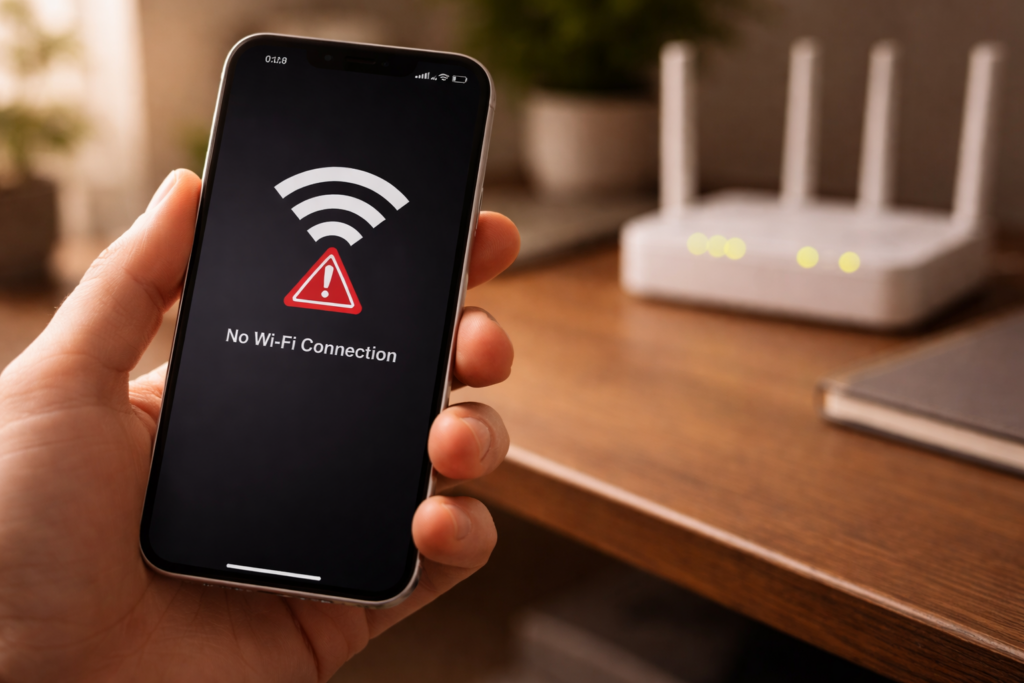
Someone walks in with a phone they bought from a stranger online. It powers on, the screen is perfect, the price was excellent. It will not take their SIM card.
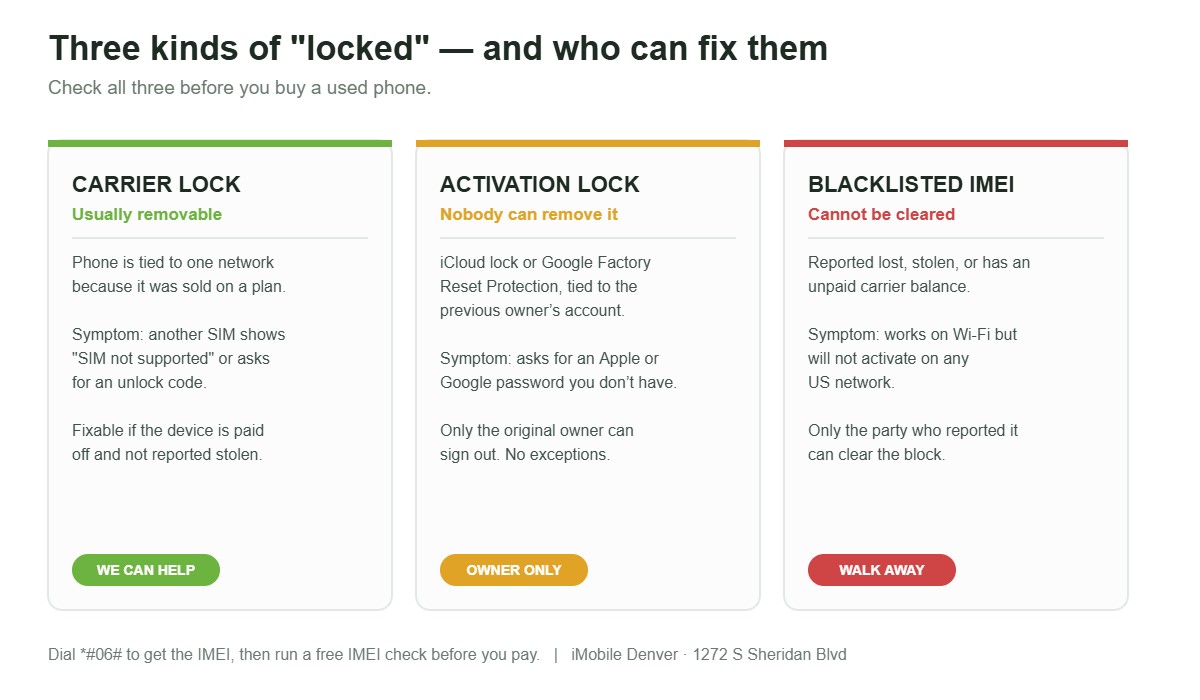
This happens constantly, and the frustrating part is that “locked” can mean three completely different things. One of them we can fix in minutes. One of them nobody on earth can fix. And one of them means the phone will never work on a US network again, no matter what anyone tells you.
Here is how to tell them apart — before you hand over money.
The three kinds of lock
1. Carrier lock — usually removable
A carrier lock ties the phone to one network. It was sold on a contract or payment plan, and the carrier locks it until their conditions are met. Insert a SIM from a different network and you get a message asking for an unlock code, or simply no service.
This is the good one. In the US it is legal to unlock a phone you own, and carriers are required to unlock eligible devices on request. Eligibility usually means the device is fully paid off, the account is in good standing, it has been active for a set period, and it has not been reported lost or stolen.
We unlock carrier-locked iPhones at our Denver shop. Bring it in and we will check what is possible before you commit to anything.
2. Activation lock — nobody can remove it
This is Apple’s iCloud Activation Lock, or Google’s Factory Reset Protection on Android. It ties the device to the previous owner’s account, and it exists specifically to make stolen phones worthless.
Be very clear on this: no repair shop, no unlock service, and no software can legitimately bypass activation lock. Not us, not anyone. Anybody who tells you otherwise is either lying or doing something you do not want to be part of. The only fix is the original owner signing out of their account.
If you are buying used, this is the one that turns a phone into a paperweight.
3. Blacklisted — the phone is finished
A blacklisted IMEI has been reported lost, stolen, or has an unpaid balance on a carrier account. It is barred from activating on US networks. The phone works fine on Wi-Fi and looks perfect, which is exactly why it gets resold to people who do not check.
Unlike a carrier lock, a blacklist cannot be removed by a shop. Only the party who reported it can clear it.
The three locks look identical from the outside. Only one of them can be removed by a repair shop.
How to check, in about three minutes
Get the IMEI. Dial *#06# on the phone and it appears on screen. Any honest seller will give you this before you meet.
Run it through a free IMEI checker to see whether it is blacklisted and whether it is carrier locked.
Check activation lock properly. The phone should boot to the initial setup screen with no account attached. If it boots to someone else’s home screen, or asks for a password you do not have, stop.
Put your own SIM in. If it says “SIM not supported” or asks for an unlock code, it is carrier locked — which may be fixable.
Check the carrier matches your network bands. An unlocked phone can still get poor coverage if it was built for a different carrier.
A seller who refuses to share the IMEI has answered your question.
Why this matters more than people think
Denver has a large second-hand phone market, and most of it is fine. The problem is that the three locks are invisible from the outside. A blacklisted iPhone and a clean iPhone look identical in a parking lot handoff.
This is a large part of why buying from a shop costs a little more. When we sell a pre-owned device, the IMEI has already been checked, activation lock is confirmed clear, and the hardware has been tested. If something is wrong, there is somewhere to go. You can see what we currently have on our buy a device page, and we offer financing on new and used devices if you would rather spread the cost.
If you are on the other side of it and want to move an old handset on, we buy devices too.
If your own phone is carrier locked
Different situation, and usually a much better one. If it is your phone, you paid for it, and the account is settled, unlocking is normally straightforward. It is worth doing even if you are not switching networks — an unlocked phone is worth noticeably more when you sell it, and it lets you use a local SIM when you travel.
Bring it to our shop on Sheridan Blvd and we will tell you what is achievable. The estimate is free, and we will be straight with you if the answer is that it cannot be done.
Find us at 1272 S Sheridan Blvd, Denver. We are closed Tuesdays; hours for the rest of the week are on our location page. Call Mehmet on (720) 224-5403, or Aria on (720) 319-9262 for service in Spanish. You can also get an instant quote before you come in.
Frequently asked questions
Is it legal to unlock my phone in the US? Yes, unlocking a phone you own is legal, and carriers are required to unlock eligible devices. Eligibility generally means the device is paid off and was not reported lost or stolen.
Can you remove iCloud activation lock? No, and neither can anyone else legitimately. Only the original owner can remove it by signing out of their Apple account. Be wary of any service claiming otherwise.
Can a blacklisted phone be fixed? Not by a repair shop. A blacklist can only be cleared by whoever reported the device. It will still work on Wi-Fi, but not on a US carrier network.
How do I find my IMEI? Dial *#06# on the keypad. It is also in Settings, and printed on the SIM tray or the original box.
Does unlocking a phone erase my data? Carrier unlocking itself does not wipe your device, but back up before any service work as a matter of course.
Will unlocking void my warranty? A legitimate carrier unlock does not. Every repair we complete carries a warranty, and we will explain what is covered before we start.
iPhone screen repair in Denver is the single most common repair we perform at iMobile Denver on Sheridan Blvd — and we’ve been doing it for over five years. A cracked screen can happen to anyone, at any time. You set your phone down wrong, it slips off a counter, it falls out of your jacket pocket on the 16th Street Mall. One second you have a working iPhone, the next you’re staring at a spiderweb of cracks or a display that’s gone dark entirely.
Most people in Denver assume a cracked iPhone screen means a long wait, an expensive bill, or a trip to the Apple Store across town. At iMobile Denver, it means a 15-minute repair, done while you wait, using top-quality brand-name parts, backed by a warranty. That’s not a marketing line — it’s what our customers experience every day.
This guide covers what’s actually happening inside a cracked iPhone screen, what the repair process looks like, what it costs in Denver, why altitude matters, and what makes a repair shop worth trusting on the Front Range.
Section 1: What’s Actually Broken When Your iPhone Screen Cracks {#section1}
iPhone screen repair in Denver starts with understanding what you’re actually dealing with — because “broken screen” can mean several different things depending on what happened.
The 3 Layers Inside Every iPhone Display
Your iPhone screen isn’t a single piece of glass. It’s a precisely engineered stack of three bonded components. The outermost layer is chemically strengthened Gorilla Glass — tougher than ordinary glass, but not indestructible against concrete sidewalks or hardwood floors. Behind the glass sits the display panel: an LCD on older iPhones and SE models, and an OLED on iPhone X and every model after. Bonded to the display is the digitizer — the touch-sensitive layer that translates every tap and swipe into an input the phone can understand.
On modern iPhones, these three layers are fused together during manufacturing. This is important because it means a crack in the outer glass can simultaneously stress the display panel beneath it — even when the display appears to be working normally right after the drop. What looks like cosmetic damage on the surface can be the beginning of a deeper failure.
The Difference Between Cosmetic and Functional Damage
Not every cracked iPhone screen needs the same urgency. A hairline fracture near the edge that doesn’t affect touch or display quality is cosmetic. The phone works. It just looks damaged. But these signs mean the damage has gone deeper and needs attention:
Lines, dark spreading patches, or green tinting running through the display
Areas of the screen not responding to touch, or ghost taps registering without any input
The screen flickering or going black while the phone still powers on and vibrates
Face ID stopped functioning after the drop
Functional display damage doesn’t improve on its own. As we’ve covered in our post on ProMotion display flickering and flex cable failures, the display stack on modern iPhones is sensitive to both physical stress and the thermal cycling that comes with everyday use. A crack introduces both — and the damage spreads.
When Face ID Is at Risk
On iPhone X and later, Face ID relies on hardware in the top of the screen assembly — a dot projector, flood illuminator, and infrared camera that work together to map your face. All of this routes through the screen. An improper screen replacement at an inexperienced shop can permanently disable Face ID because the Face ID module isn’t correctly transferred. Once it’s disabled by a bad repair, Apple’s security architecture prevents any third party from restoring it. This is why choosing an experienced shop for iPhone screen repair in Denver isn’t just about getting a good-looking display — it’s about protecting critical functionality.
Section 2: The iPhone Screen Repair Process at iMobile Denver {#section2}
Here’s what happens when you bring your cracked iPhone into iMobile Denver on Sheridan Blvd.
Instant Quote Before You Come In
Use our instant quote tool to get a transparent, accurate price for your specific iPhone model and issue before you visit. Different models use different display assemblies — the quote reflects your actual device, not a generic estimate. First-time customers get $10 off.
The Repair — 15 Minutes for Most Models
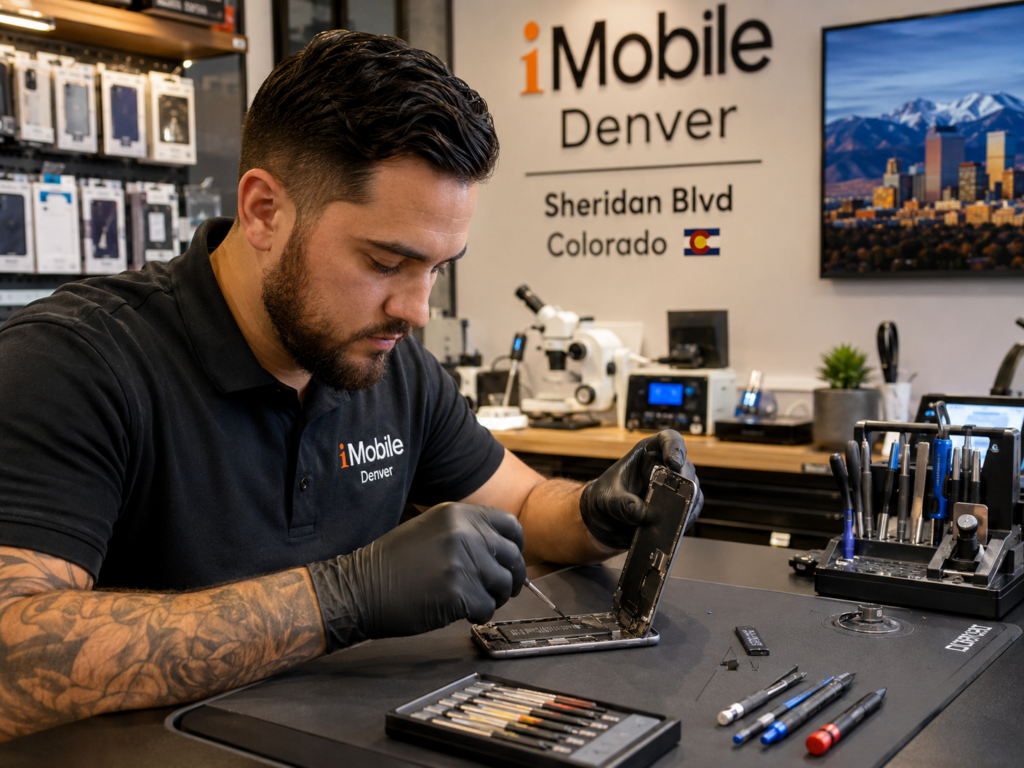
iPhone screen replacement at iMobile Denver is a precision process our technicians perform daily. The damaged display assembly is separated using controlled heat, display cables are carefully disconnected, and the Face ID module, front camera, and earpiece speaker are transferred to the replacement display. The new screen is installed, adhesive is properly applied, and the phone is reassembled.
For most iPhone models, this takes approximately 15 minutes. You wait in the shop. You leave with a working screen.
We use top-quality brand-name parts in every repair. This is the commitment that defines how we operate. Cheap aftermarket displays look fine for a few weeks before showing their true quality — duller brightness in Denver’s sunny outdoor conditions, colours that shift at off-angles, and touch responsiveness that degrades at the screen edges. Our parts don’t do that. When we fix your device, we want it to stay fixed.
Testing Before You Leave
Every repaired iPhone is tested before it goes back in your hands. We verify touch sensitivity across the full screen, check display brightness and colour accuracy, confirm Face ID is working correctly, and test the front camera and earpiece. You see all of this before you walk out. If anything is off, we address it before you leave — not after.
Section 3: What Does iPhone Screen Repair Cost in Denver? {#section3}
The cost of iPhone screen repair in Denver varies based on your specific model and the type of damage.
Model Determines Parts Cost
An iPhone SE screen repair and an iPhone 16 Pro Max screen repair are not the same job or the same cost. Older LCD displays cost less than newer OLED panels. Pro models with ProMotion, always-on displays, and Dynamic Island use premium display assemblies with higher component costs. Always provide your exact model — not just “iPhone” — when using the instant quote tool to get an accurate price.
The Type of Damage Matters
If only the outer glass is cracked and the OLED functions perfectly with Face ID intact, you’re looking at a standard screen swap — the most common and most affordable outcome. If the OLED panel has dead zones, lines, or spreading discoloration, the panel itself has failed. If Face ID stopped working after the drop, the repair requires careful module transfer and post-repair configuration. Our technicians handle all of these correctly on every job.
Financing Available
Don’t let cost prevent you from getting your phone fixed properly. iMobile Denver offers financing options that let you get the repair done today and manage the cost over time. Getting your iPhone repaired on a payment plan is almost always a better financial outcome than continuing to use a damaged phone or buying a replacement.
30-Day Warranty Included
Every screen repair comes with a 30-day warranty on parts and workmanship. If something goes wrong with the repair within that period for a covered reason, we take care of it at no charge.
Section 4: How Denver’s Altitude and Climate Affect Your Cracked Screen {#section4}
iPhone screen repair in Denver carries one consideration that doesn’t apply in most other cities — Colorado’s environment is genuinely harder on phone hardware than most people realize.
Altitude and Atmospheric Pressure
Denver sits at 5,280 feet above sea level. The lower atmospheric pressure at this elevation subtly affects the thermal management of tightly packed electronics. More practically, a phone with an internal display fracture — even one not yet visible on the surface — experiences slightly less external pressure holding the layers together. This allows micro-fractures to propagate faster than they would at sea level.
Temperature Swings Stress the Display Stack
Colorado is notorious for dramatic daily temperature swings. A cold January morning walk to your car, a warm drive to work, a heated office, a cold parking garage — your phone’s display stack goes through significant thermal expansion and contraction throughout a single Denver day. Every cycle flexes the adhesive bonding between the glass, display panel, and digitizer. On a healthy screen, this is imperceptible. On a cracked screen with internal damage, each cycle can advance the fracture further.
According to research published by NIST (National Institute of Standards and Technology), thermal cycling is one of the primary mechanisms of adhesive failure in bonded structures — exactly the situation inside a fused iPhone display stack. This is why screens that were “still working” after a drop in Denver often fail completely within a week in winter.
The Practical Takeaway
If your iPhone screen cracked in Denver, don’t wait. The combination of altitude, temperature swings, and dry air means that what’s cosmetic today has a higher chance of becoming functional damage within days than it would in a more stable climate. A 15-minute repair now is almost always simpler and cheaper than a more involved repair after the OLED has failed.
Section 5: Why iMobile Denver Is the Right Choice for iPhone Screen Repair in Denver {#section5}
5+ Years on Sheridan Blvd — Locally Owned and Trusted
iMobile Denver has served the Sheridan Blvd neighborhood and the wider Denver metro area for over five years. We’re not a national chain or a franchise operating from a playbook. We’re a locally owned shop where Mehmet and Aria know their customers by name and where the same experienced technicians perform your repair every visit.
We also serve Denver’s Spanish-speaking community directly — Aria is available at (720) 319-9262 for customers who prefer to communicate in Spanish.
15-Minute Screen Repairs While You Wait
This is real. Most iPhone screen repairs at iMobile Denver are completed in approximately 15 minutes. You don’t leave your phone and come back tomorrow. You wait, you watch if you’d like, and you leave with a working iPhone. For Denver residents who depend on their phone for work, navigation, communication, and everything else, that turnaround matters.
If repair doesn’t make financial sense for a heavily damaged or very old phone, iMobile Denver has other options. Our refurbished device inventory carries inspected iPhones at a fraction of retail cost. We also buy used and broken phones for fair same-day payment. And financing means cost is never a reason to leave your phone unrepaired. Check our device repair FAQs and common repair questions for more detail on what to expect.
FAQs: iPhone Screen Repair Denver {#faqs}
How long does iPhone screen repair in Denver take at iMobile Denver? Most iPhone screen repairs are completed in approximately 15 minutes. More complex cases — phones with multiple issues or models requiring more extensive disassembly — may take longer. We’ll give you an accurate time estimate after confirming your model and assessing the damage.
Will Face ID still work after my screen is replaced? Yes — at iMobile Denver, Face ID is preserved correctly on every screen replacement. The Face ID hardware lives inside the screen assembly and must be carefully transferred to the replacement display and properly configured. We do this correctly on every repair. A shop that mishandles this step can permanently disable Face ID, and no independent technician can restore it afterward.
What warranty comes with iPhone screen repair in Denver? Every screen repair at iMobile Denver comes with a 30-day warranty on parts and workmanship. If the repair fails for a covered reason within that window, we fix it at no charge.
My iPhone screen cracked but still works fine — should I repair it now or wait? We strongly recommend repairing sooner rather than later in Denver. The combination of altitude, daily temperature swings, and dry air means that cosmetic screen damage here progresses to functional damage faster than in most other cities. A 15-minute repair today is almost always simpler and cheaper than a panel replacement after the display fails.
Is it worth repairing an older iPhone screen or should I just get a new phone? In most cases, repair is the better financial decision — even on phones 3–4 years old. Use our instant quote tool to see the repair cost for your specific model and compare it against the cost of a replacement. Our refurbished device inventory is also worth checking if you’re considering an upgrade.
Do you offer any discounts on iPhone screen repair in Denver? First-time customers get $10 off their repair. We also have 20% off accessories. Financing is available if you need to spread the cost over time.
This article is for general informational purposes only. For an accurate assessment of your specific iPhone and damage, visit iMobile Denver at 1272 S Sheridan Blvd, Denver CO 80232, or use our instant quote tool to get started.
iPhone battery replacement in Denver is one of the most common repairs we perform at iMobile Denver on Sheridan Blvd — and it’s also one of the most underrated. Most people don’t think about their battery until their phone starts dying at noon, shutting off randomly at 30%, or refusing to turn on at all. By then, what could have been a quick, affordable fix has been quietly draining your productivity for months.
Denver’s climate doesn’t help. The combination of high altitude, dramatic temperature swings, and dry air all put additional stress on lithium-ion batteries compared to lower-elevation cities. If your iPhone has been behaving strangely with its charge, there’s a good chance the battery is the reason — and there’s an equally good chance we can fix it in about 30 minutes.
This guide covers the 5 signs your iPhone battery is failing, how the replacement process works, what it costs in Denver, and what to look for in a repair shop you can trust.
Section 1: 5 Signs Your iPhone Battery Needs Replacing {#section1}
iPhone battery replacement in Denver starts with knowing when you actually need one. Here are the five most reliable signs.
Sign 1: Your Battery Drains Way Faster Than It Used To
This is the most obvious one, but the progression is gradual enough that people often don’t notice until it’s extreme. A healthy new iPhone battery should last a full day of normal use. When it starts dying by early afternoon despite normal usage — or worse, by mid-morning — the battery capacity has degraded past the point where it can reliably power the device.
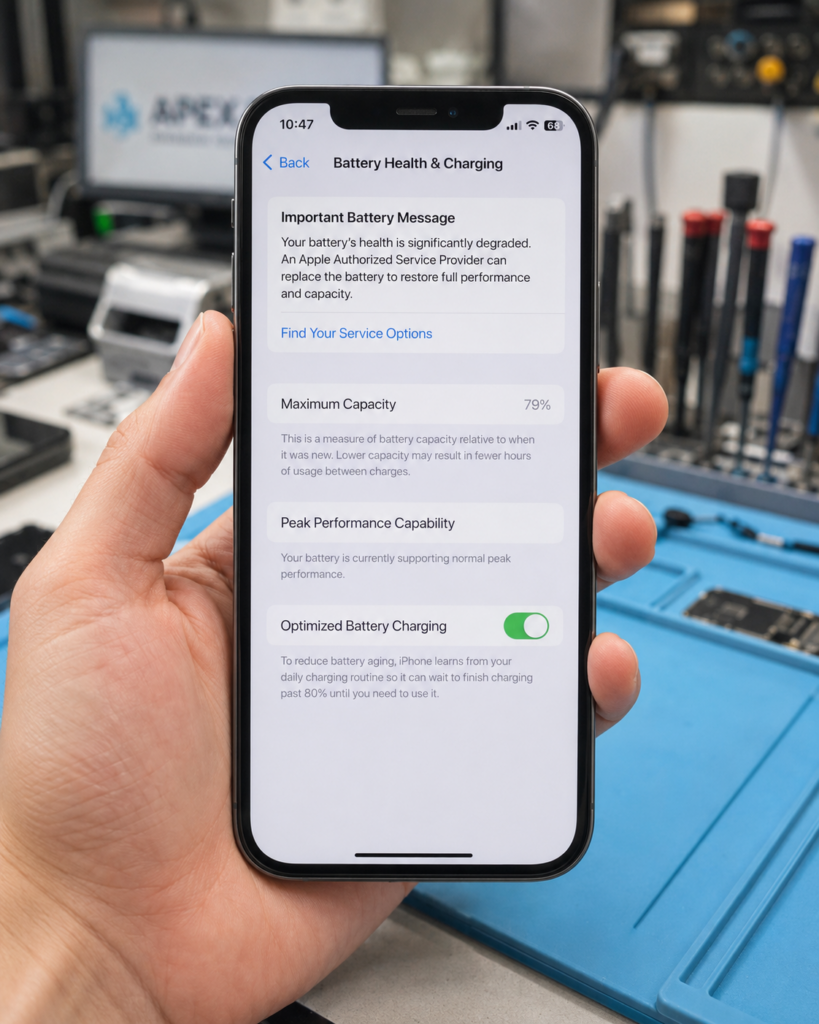
Apple’s built-in Battery Health tool is the clearest indicator. Go to Settings → Battery → Battery Health & Charging. If your Maximum Capacity is below 80%, Apple itself recommends battery replacement. Below 79% and iOS may start throttling your processor to prevent unexpected shutdowns — which is why older iPhones sometimes feel noticeably slower before the battery is replaced.
Sign 2: Your iPhone Shuts Off Randomly — Even at 20% or Higher
This is a classic sign of battery degradation. A worn-out battery can’t deliver the peak current bursts that modern iPhones need for processor-intensive tasks — so when demand spikes, the voltage drops suddenly and the phone shuts itself off as a protective measure. If your iPhone is shutting down at 20%, 30%, or even 40% charge and then turning back on with battery remaining, the battery is failing.
This is a severe form of the same problem. When a battery degrades far enough, it can no longer hold a charge that sustains normal operation. The phone appears to charge correctly, reaches 100%, and then dies almost immediately once unplugged. In extreme cases, the phone only stays on while connected to power. If this is happening, the battery has likely deteriorated to the point where it’s essentially bypassed — the device is running directly off the charger.
Sign 4: Your iPhone Gets Extremely Hot During Normal Use
Some heat during gaming or intensive tasks is normal. But if your iPhone gets noticeably hot during basic activities like scrolling, texting, or making calls — especially paired with fast battery drain — the battery is working harder than it should to compensate for its reduced capacity. Thermal stress is also one of the reasons battery degradation accelerates in Denver, where temperature swings between a cold morning commute and a warm afternoon are extreme.
Sign 5: iOS Shows a Battery Health Warning
Go to Settings → Battery → Battery Health & Charging. If you see a message saying “Your battery’s health is significantly degraded” or a recommendation to service your battery, iOS is telling you directly that replacement is needed. Don’t dismiss this notification — it’s based on real internal measurements of your battery’s charge capacity and output stability.
Section 2: How iPhone Batteries Work — and Why They Fail {#section2}
Understanding why iPhone batteries degrade helps explain why iPhone battery replacement in Denver makes sense rather than just buying a new phone.
Lithium-Ion Chemistry and Charge Cycles
iPhone batteries use lithium-ion chemistry, which stores energy by moving lithium ions between electrodes. Every charge-discharge cycle slightly reduces the battery’s capacity. Apple rates iPhone batteries to retain approximately 80% of their original capacity at 500 complete charge cycles — roughly 1.5 to 2 years of typical daily charging.
After that threshold, the degradation curve steepens. A battery at 500 cycles with 80% capacity might drop to 70% at 600 cycles, then 60% at 700 cycles. The practical result is that every generation of the same iPhone model starts performing worse and worse as the battery ages — not because the hardware changed, but because the energy source is depleting.
Why Denver Accelerates Battery Degradation
Denver sits at 5,280 feet above sea level, and the surrounding area goes much higher. Several factors specific to this environment accelerate lithium-ion degradation. Lower atmospheric pressure slightly affects the thermal management of densely packed battery cells. More significantly, the temperature extremes common in Colorado — cold winter mornings, warm afternoons, rapid changes — put repeated thermal stress on the battery chemistry. Charging a cold battery rapidly is particularly damaging, and Denver’s winters mean this happens frequently.
According to Battery University, lithium-ion cells are most stressed by heat exposure and by charging at low temperatures — both of which are common in Colorado. This is why iPhones in Denver often show battery degradation faster than the same models used in milder climates.
When Replacement Makes More Sense Than a New Phone
A battery replacement at iMobile Denver costs a fraction of what a new or refurbished iPhone costs. If your iPhone’s hardware is otherwise in good condition — display is fine, camera works, no major damage — a battery replacement is almost always the smarter financial decision. It restores the performance the phone had when it was new and extends its useful life by 2–3 years in most cases.
Section 3: What iPhone Battery Replacement in Denver Actually Looks Like {#section3}
Here’s exactly what happens when you bring your iPhone in for a battery replacement at iMobile Denver.
Step 1: Instant Quote Before You Commit
Use our instant quote tool to get a transparent price for your specific iPhone model before you visit. Different models have different battery assemblies and labor requirements — the quote is based on your exact device, not a generic estimate.
Step 2: Diagnosis and Battery Health Check
When you arrive, our technician checks your Battery Health reading, confirms the symptoms you’re experiencing, and assesses whether the battery is definitively the cause. In some cases, what presents as a battery issue is actually a charging port problem or a software issue — we’ll tell you honestly what we find before starting any work.
Step 3: The Replacement
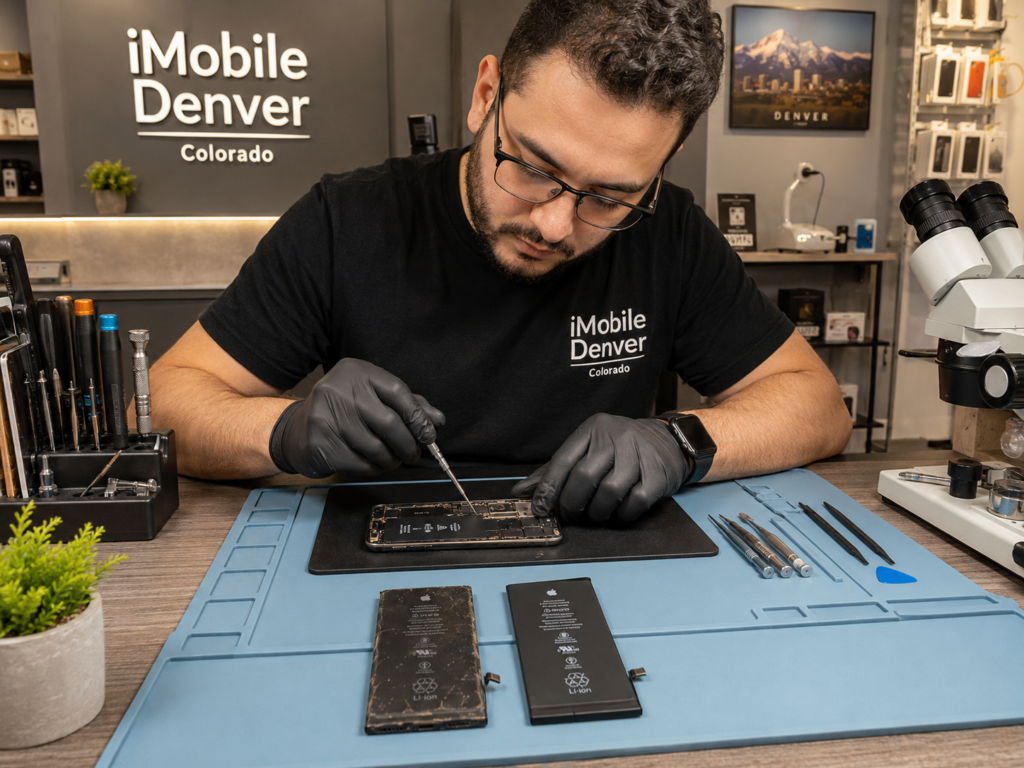
iPhone battery replacement involves careful disassembly, removal of the old battery (which uses adhesive strips on most modern models), and installation of a new high-quality replacement cell. On newer iPhone models, the process also involves display removal. Our technicians are experienced with every iPhone generation and complete most battery replacements in about 30 minutes while you wait.
We use top-quality brand-name parts in every repair. That applies to batteries the same as screens. Cheap replacement batteries degrade faster, have less accurate capacity readings, and in rare cases can create safety concerns. Quality parts cost a bit more to source — and that’s reflected in a repair that actually solves the problem.
Step 4: Testing Before You Leave
Before your iPhone goes back in your hands, we test the new battery. We verify the Battery Health reading in Settings, confirm proper charging behavior, check that the device doesn’t show any unexpected temperature warnings, and run the phone through a basic function check. You see all of this before you walk out.
Section 4: What Does iPhone Battery Replacement Cost in Denver? {#section4}
The cost of iPhone battery replacement in Denver varies based on your specific model.
Model Matters
Battery assemblies differ significantly across the iPhone lineup. Older models with simpler disassembly are less expensive to service. Newer models — particularly iPhone 12 and later, which require display removal for battery access — involve more labor. Pro Max models have larger battery assemblies and more complex access routes. Always provide your exact model when requesting a quote.
Quality Parts — What You’re Actually Paying For
We use top-quality brand-name battery replacements, not the cheapest cells available. The difference shows up in accurate capacity readings, consistent performance over time, and proper thermal behavior. A battery that reports 100% capacity but is actually a low-grade cell will degrade rapidly and behave erratically — which is worse than not replacing it at all.
Financing Available
If cost is a concern, iMobile Denver offers financing options for repairs. You can get your iPhone working properly today and manage the cost over time.
First-Time Customer? $10 Off
New to iMobile Denver? You get $10 off your first repair. Mention it when you come in.
30-Day Warranty
Every battery replacement comes backed by a 30-day warranty on parts and labor. If something goes wrong with the repair within that period, we take care of it.
Section 5: Why iMobile Denver Is the Right Choice for iPhone Battery Replacement in Denver {#section5}
5+ Years Serving Denver — Locally Owned and Operated
iMobile Denver has been serving the Sheridan Blvd neighborhood and the wider Denver metro area for over five years. We’re not a franchise. We’re a locally owned shop where the same technicians work on your device every visit, and where Mehmet and Aria know their customers by name. That continuity shows up in the consistency of our work and the trust we’ve built in this community.
15–30 Minute Repairs While You Wait
iPhone screen repairs take about 15 minutes. Battery replacements are typically done in about 30 minutes. You don’t drop your phone off and wonder where it is — you wait, and you leave with a working device. We also offer a Spanish-language line at (720) 319-9262 for customers who prefer to communicate in Spanish.
If battery replacement doesn’t make financial sense for a heavily damaged or very old phone, we can help with that too. Our device inventory has quality refurbished iPhones, and we buy used and broken phones for fair same-day payment. Check our FAQs for answers to common repair questions.
FAQs: iPhone Battery Replacement Denver {#faqs}
How long does iPhone battery replacement take at iMobile Denver? Most iPhone battery replacements are completed in about 30 minutes while you wait. We’ll give you an accurate time estimate after confirming your specific model.
How do I know if I need a battery replacement or something else? Check Settings → Battery → Battery Health & Charging. If Maximum Capacity is below 80%, or if you’re seeing a service recommendation, battery replacement is almost certainly the fix. If you’re unsure, bring it in — our diagnostic is free and we’ll tell you honestly what we find before recommending any repair.
Will iPhone battery replacement affect my Face ID or other features? No. Battery replacement doesn’t affect Face ID, Touch ID, cameras, or any other iPhone feature. It’s a direct cell swap that restores power performance without touching any other component.
Is it worth replacing the battery on an older iPhone? In most cases, yes — as long as the rest of the phone is in good working condition. A battery replacement costs a fraction of a new device and can restore performance significantly. Use our instant quote tool to see the cost for your exact model and decide from there.
Does iPhone battery replacement void my Apple warranty? If your iPhone is still under Apple warranty or AppleCare+, check your coverage first — Apple may cover battery replacement at a lower cost if capacity is below 80%. If your warranty has expired, a third-party repair at iMobile Denver is a great option. Note that third-party repairs may affect any remaining Apple warranty — our technicians can walk you through this when you come in.
Do you use genuine Apple batteries? We use top-quality brand-name replacement batteries. These match the original battery in capacity, thermal performance, and compatibility with iOS Battery Health reporting. We’ll be transparent about what we’re installing and why.
This article is for general informational purposes only. For an accurate assessment of your specific iPhone battery and the right repair approach for your situation, visit iMobile Denver at 1272 S Sheridan Blvd, Denver CO 80232, or use our instant quote tool to get started.
Knowing how to check iPhone battery health is one of the most useful things any iPhone owner can learn — and it takes less than 2 minutes. Whether your phone has been draining faster than usual, shutting off unexpectedly, or you just want to know where things stand, Apple’s built-in Battery Health tool gives you a clear, honest picture.
The problem is that most people don’t know it exists, don’t know where to find it, or don’t understand what the numbers mean once they do. This guide walks you through exactly how to check your iPhone battery health, what every reading means, and what action to take based on what you find.
At iMobile Denver on Sheridan Blvd, battery-related issues are one of the most common reasons customers walk through our door. Most of them had no idea their battery was the problem until they checked. Let’s fix that.
Section 1: How to Check iPhone Battery Health — Step by Step {#section1}
How to check iPhone battery health is straightforward once you know where to look. Here’s the exact path:
Step 1: Unlock your iPhone and open the Settings app (the grey gear icon on your home screen).
Step 2: Scroll down and tap Battery.
Step 3: On the Battery screen, tap Battery Health & Charging.
Step 4: Look at the Maximum Capacity percentage at the top of the screen.
That’s it. The number you see is your battery’s current health. A brand new iPhone shows 100%. That number decreases over time as the battery goes through charge cycles.
What If I Don’t See Battery Health & Charging?
This feature is available on iPhone 6 and later running iOS 11.3 or later. If you have an older device that doesn’t show this menu, your iOS version may need updating — go to Settings → General → Software Update and install the latest available version. If your iPhone is too old to support iOS 11.3, the Battery Health feature isn’t available on your model.
On iPhone 15 and Later — Cycle Count Is Also Visible
Apple expanded the Battery Health information starting with iPhone 15. In addition to Maximum Capacity, you can also see your Cycle Count (the number of complete charge cycles the battery has completed) and your manufacture date. This gives you a more complete picture of how the battery has been used. To find this, go to Settings → General → About and scroll down to find battery information.
Section 2: What the Battery Health Numbers Actually Mean {#section2}
Once you know how to check iPhone battery health, the next step is understanding what you’re looking at.
Maximum Capacity — The Core Number
Maximum Capacity is expressed as a percentage of your battery’s original design capacity. A reading of 87% means your battery can currently hold 87% of the charge it could hold when the iPhone was new. The remaining 13% of capacity has been permanently lost through normal use and chemical aging.
This matters because a lower Maximum Capacity means:
Shorter battery life between charges
Less ability to handle processor-intensive tasks without voltage drops
Increased risk of unexpected shutdowns, especially in cold weather or under heavy load
What Is a Normal Maximum Capacity?
According to Apple’s official battery service guidance, iPhone batteries are designed to retain up to 80% of their original capacity at 500 complete charge cycles. One complete charge cycle is 100% of the battery’s capacity used — which could happen over one day or across several partial charges.
In practical terms, at roughly 1.5–2 years of normal daily use, most iPhones reach the 500-cycle mark and are typically sitting between 80–88% capacity. Whether that’s “good enough” depends on how heavily you use the phone and how much range you need in a day.
The Optimized Battery Charging Setting
Just below Maximum Capacity, you’ll see an Optimized Battery Charging toggle. When this is turned on, iOS learns your daily charging patterns and holds the charge at 80% until it predicts you’ll need the phone fully charged — typically right before you normally unplug it in the morning. This is worth keeping enabled. According to Apple’s own guidance, keeping a lithium-ion battery at 100% charge for extended periods accelerates degradation. Optimized charging is one of the simplest things you can do to slow the decline of your battery health over time.
Section 3: 5 Battery Health Readings and What to Do About Each {#section3}
Now that you know how to check iPhone battery health and what the numbers mean, here’s a practical breakdown of what to do at each level.
100% – 90%: Excellent
Your battery is in great shape. Normal daily charging is fine. Enable Optimized Battery Charging and avoid leaving the phone at 100% plugged in overnight if possible. No action needed.
89% – 80%: Good, But Worth Monitoring
Your battery has experienced some degradation but is still within Apple’s normal service range. You may start noticing slightly shorter battery life compared to when the phone was new. Keep an eye on it. If you’re using the phone heavily and range is becoming an issue, a replacement at this stage is perfectly reasonable and will restore performance significantly.
79% – 70%: Declining — Replacement Recommended
Below 80% is Apple’s own threshold for recommending battery service. At this level, iOS may begin throttling your processor’s peak performance to prevent unexpected shutdowns — which is why iPhones often feel noticeably slower before a battery replacement, not after. You’ll likely see a service recommendation message directly in the Battery Health screen. This is a good time to bring your iPhone to iMobile Denver for a replacement.
69% – 60%: Significantly Degraded
At this level, your phone is running on well under two-thirds of its original battery capacity. Daily charging range is severely reduced, unexpected shutdowns are common, and the phone may struggle to handle peak loads. Replacement is no longer optional for comfortable daily use.
Below 60%: Replace Immediately
A battery below 60% capacity is effectively worn out. The phone will behave unpredictably — shutting off at high percentages, draining extremely fast, refusing to charge past certain levels, or only working while plugged in. This level of degradation can also start putting stress on other components. Replacement should happen as soon as possible.
Section 4: How to Make Your iPhone Battery Last Longer {#section4}
Once you know how to check iPhone battery health, you’ll want to slow the decline going forward. Here are the most effective habits backed by battery chemistry research.
Keep Charging Between 20% and 80%
This is the single most impactful thing you can do. Lithium-ion batteries degrade fastest at the extremes — charging from 0% to 100% stresses the chemistry more than staying in the middle range. If you can’t always avoid full charges, at least avoid letting the battery hit 0% regularly.
Don’t Charge in Extreme Cold or Heat
In Denver’s climate, this matters. Charging a cold iPhone — brought in from a freezing car, for example — causes lithium plating on the anode that permanently reduces capacity. Charging in extreme heat similarly accelerates chemical aging. Try to let your phone reach room temperature before charging when it’s been in cold conditions.
Use Optimized Battery Charging
As mentioned earlier, this iOS feature prevents your battery from sitting at 100% unnecessarily and meaningfully slows the rate of capacity loss over time. Keep it on.
Reduce Background Activity
Background App Refresh, location services running constantly, and push email for multiple accounts all keep the processor active when you’re not using the phone — which drains the battery and requires more frequent charging cycles. Go to Settings → General → Background App Refresh and turn off apps that don’t need real-time updates.
Avoid Wireless Charging for Every Charge
MagSafe and Qi wireless charging are convenient but generate more heat than wired charging — and heat is the enemy of battery longevity. Use wireless charging selectively, not as your primary daily charger. A standard Lightning or USB-C cable generates less thermal stress on the battery.
Section 5: When Checking Isn’t Enough — Signs You Need a Replacement {#section5}
Knowing how to check iPhone battery health is helpful, but sometimes the Battery Health screen doesn’t tell the full story. Here are the real-world signs that replacement is needed regardless of what the percentage shows.
Unexpected Shutdowns Under Load
If your iPhone shuts off during demanding tasks — gaming, taking photos, video calls — even when the battery shows 30% or higher, the battery can no longer deliver peak current. This is a hardware failure, not a software issue, and it will get worse over time.
The Phone Gets Unusually Hot During Normal Use
A battery working harder than it should generates excess heat as a byproduct. If your iPhone gets noticeably warm during texting, browsing, or casual use — especially paired with fast drain — the battery is the likely cause.
Swollen or Physically Deformed Phone
If your iPhone looks slightly thicker than usual, or the screen appears to be slightly lifted at one edge, the battery may be swelling. A swollen lithium-ion battery is a safety concern. Stop charging the phone and bring it in immediately. Don’t try to open the phone or puncture the battery. Contact iMobile Denver right away if you suspect this is happening.
Battery Health % Drops Rapidly Week to Week
Healthy batteries lose roughly 1% of capacity every 1–2 months under normal use. If your Maximum Capacity is dropping noticeably week to week, the battery has a manufacturing defect or has been damaged by charging habits and should be replaced.
FAQs: How to Check iPhone Battery Health {#faqs}
Can I check iPhone battery health without going into Settings? The quickest way is Settings → Battery → Battery Health & Charging. There’s no shortcut or widget for this on the lock screen by default. Third-party apps claim to show battery health data, but they access the same underlying iOS information — the Settings menu is the most accurate and direct source.
Is 85% battery health good for a 2-year-old iPhone? Yes — 85% after two years of normal use is within Apple’s expected range. The phone should still perform well for daily use. If you’re noticing range issues, a replacement will make a meaningful difference. If battery life still feels acceptable, monitoring it every month or two is sufficient.
Does checking battery health damage the battery? No. Checking the Battery Health screen is a passive read of stored data — it doesn’t stress the battery or run any tests. Check as often as you like.
My battery health is 100% but my phone still dies fast. What’s wrong? A 100% reading on a newer iPhone usually means the battery genuinely is in good condition. If battery life is still poor, the issue is more likely software-related — background apps, display brightness, location services, or a rogue app draining power. Check Settings → Battery to see which apps are consuming the most power. If software fixes don’t help, bring it in for a free diagnostic at iMobile Denver.
How much does iPhone battery replacement cost in Denver? The cost varies by model. Use our instant quote tool to get a transparent price for your specific iPhone before you come in. First-time customers also get $10 off.
Can iMobile Denver replace the battery on any iPhone model? Yes. We replace batteries on all iPhone models from older generations through the current lineup. Visit our iPhone repair page for more details, or stop in at 1272 S Sheridan Blvd during business hours — no appointment needed.
This article is for informational purposes only. For an accurate assessment of your specific iPhone battery and whether replacement is the right call, bring your device into iMobile Denver at 1272 S Sheridan Blvd, Denver CO 80232, or use our instant quote tool to get started.
You dropped your iPhone and flipped it over to check the damage. The front screen looked fine. But the back? It was shattered.
Back glass damage is one of the most common iPhone repairs in Denver. Yet most people have no idea what their options are. And many shops either refuse to do it or charge prices close to a brand-new phone.
iPhone back glass repair is not as simple as a screen replacement. But it is absolutely worth doing — especially at the right shop. This guide explains what is really involved, why the repair costs what it does, and how to make the smartest decision for your device.
Section 1: Why iPhone Back Glass Breaks So Easily
It seems counterintuitive. Glass on the back of a phone — why is it even there?
Apple introduced glass backs with the iPhone 8. The reason was wireless charging. Wireless charging cannot pass through aluminum or metal, so Apple switched to glass. Since then, every iPhone model from the 8 onwards has used glass on the back.
The problem is simple. Glass shatters on impact. And back glass is thinner than front glass. It also has less protective framing around it compared to the front display.
On top of that, Denver’s altitude and temperature swings add stress. The glass expands slightly in summer heat and contracts in cold winters. Over time, this weakens the glass before any drop even happens.
So when you drop your iPhone — even from a short height — the back glass often takes the worst of it.
Section 2: Why Most Shops Avoid Back Glass Repair
Here is something most shops will not say out loud: back glass repair is difficult. That is why many shops either refuse it or charge extremely high prices.
The Problem With Apple’s Design
On iPhones 8 through 16, Apple fuses the back glass directly to the metal frame. There is no simple way to slide it off. Instead, a technician must either use a laser machine to separate the glass cleanly, or carefully remove it by hand using heat and precision tools.
Without a laser machine, removing the back glass risks damaging the wireless charging coil, the internal components, and the frame itself. That is a risk that inexperienced shops cannot afford to take.
The Cost of Doing It Right
A professional laser back glass repair machine costs thousands of dollars. Not every shop invests in one. So when you call around for back glass repair quotes and get wildly different prices, this is usually why.
Shops without the right equipment either refuse the job or quote high to cover the extra risk and labor involved. Additionally, some shops will try to replace the entire back housing — which means removing every internal component and reassembling them in a new chassis. That adds hours of labor and significant cost.
What This Means for You
It means you should not just go with the cheapest quote. Instead, ask the shop directly: do you use a laser machine for back glass removal? If the answer is no, look elsewhere.
At iMobile Denver, we handle iPhone repair with professional equipment and top-quality parts. You can get an instant quote for your specific iPhone model before you even walk through the door.
Section 3: Should You Repair It or Ignore It?
Many iPhone owners ask this question. The back is cracked, but the phone still works. Why bother?
Here are four strong reasons to get it fixed.
1. The Crack Will Spread
A single crack rarely stays small. Every time you set the phone down or put it in your pocket, pressure and friction extend the crack further. Within weeks, a small crack often becomes a fully shattered back.
2. Your Phone Loses Water Resistance
iPhones from the XR onwards carry an IP water-resistance rating. However, that rating depends entirely on the back glass being intact and sealed. A cracked back removes that protection completely. Therefore, even brief water exposure — rain, a wet counter — becomes a risk.
3. Sharp Glass Can Cause Cuts
Shattered back glass has sharp edges. These can cut your hands or tear through pockets and bags. This is a real safety concern, especially for kids using a parent’s phone.
4. Your Resale or Trade-In Value Drops
If you plan to sell or trade in your iPhone, a cracked back significantly reduces its value. In fact, many buyback programs reject phones with shattered backs entirely. A relatively affordable back glass repair can recover hundreds of dollars in trade-in value.
Section 4: What to Expect From iMobile Denver
At iMobile Denver on Sheridan Blvd, we repair back glass on all major iPhone models. Most repairs are completed the same day. In many cases, we can have your phone ready in 30 minutes or less.
We use quality parts that match the look and function of the original glass. Your wireless charging will still work. Your MagSafe will still work. The phone will feel like new in your hand again.
All repairs come with our standard warranty. So if anything is not right after the repair, we will take care of it.
You can also apply for financing if cost is a concern. Our financing option makes it easy to pay over time for larger repairs.
Additionally, if you have other damage on your phone at the same time — a cracked front screen, a weak battery, a damaged charging port — we can handle everything in one visit. There is no need to make multiple trips.
Check our repair services page to see every repair we offer. Or browse our FAQs if you have questions about the repair process before coming in.
Section 5: Conclusion and Final Thoughts
A cracked iPhone back glass is frustrating. But it is fixable. And the longer you wait, the worse it gets.
The key is choosing a shop that has the right equipment and experience. Not every shop does back glass repair properly. At iMobile Denver, we do.
Stop by our Sheridan Blvd location, get a quote online, or call us at (720) 224-5403. We also have a Spanish-speaking line at (720) 319-9262.
Your iPhone should look as good as it works. Let us fix it.
FAQs
Is iPhone back glass repair worth it? Yes, in most cases. It restores water resistance, removes the safety risk from sharp glass, and recovers resale value. The cost is almost always far less than buying a new phone.
How long does back glass repair take? At iMobile Denver, most back glass repairs are completed the same day. Many are done in 30 minutes or less.
Will my wireless charging still work after back glass repair? Yes. We take care to protect the wireless charging coil during the repair. After the fix, wireless charging and MagSafe work normally.
What iPhone models do you repair back glass on? We repair back glass on iPhone 8, X, XR, XS, 11, 12, 13, 14, 15, and 16 series. Get an instant quote to confirm pricing for your specific model.
Can I use a skin or case instead of repairing the back glass? A case can cover the cosmetic damage. However, it does not restore water resistance or stop the glass from cracking further. It also does not remove the sharp edge risk. Repair is the only real fix.
Do you offer financing for repairs? Yes. You can apply for financing directly on our website. It is a great option if you want to spread the cost of a larger repair.
Disclaimer
This article is for informational purposes only. Back glass repair complexity varies by iPhone model and damage level. iMobile Denver recommends an in-person assessment before any repair decision. Repair outcomes depend on the specific device condition. Contact us for a free diagnostic before proceeding with any repair.
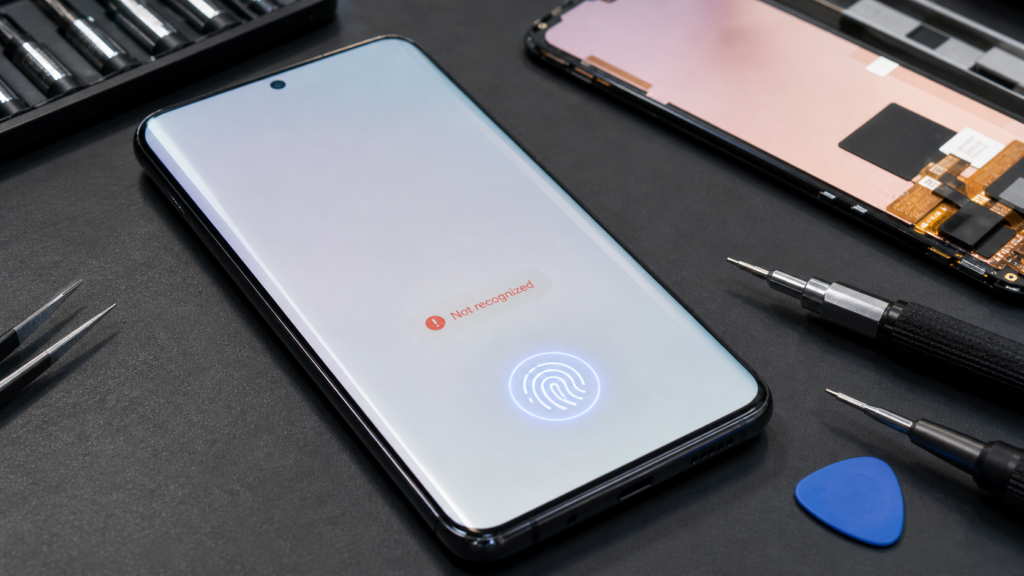
You get your screen replaced. Everything looks perfect — bright, clear, no cracks. Then you press your thumb to the display and nothing happens. No unlock. No response. Just a quiet prompt to use your PIN instead. If your fingerprint sensor not working after screen replacement is your current reality, you are not imagining it. And you are definitely not alone.
In 2026, under-display fingerprint sensors are built into the vast majority of Android flagships and a growing number of mid-range devices. They work beautifully — until a screen repair changes something underneath. This guide is built from real cases we handle at iMobile Denver every week. We will break down exactly why this happens, how to tell whether a software fix is all you need, and when the hardware genuinely needs another look.
Section 1: How Under-Display Fingerprint Sensors Actually Work
Before troubleshooting, it helps to understand what the sensor is doing in the first place. Under-display fingerprint sensors in 2026 fall into two main types: optical and ultrasonic.
Optical sensors function like a tiny camera behind the glass. When you press your finger to the screen, the OLED display flashes briefly, illuminates the fingerprint ridges, and captures an image through the panel. That image is then matched against a stored template. Optical sensors are common in mid-range phones and many budget Androids.
Ultrasonic sensors — like the Qualcomm 3D Sonic Max sensor used in Samsung flagship devices — work differently. They transmit sound waves through the display, build a three-dimensional ridge map of your fingertip, and verify it against a stored 3D profile. They are more accurate, more secure, and considerably more sensitive to physical changes in the display above them.
Both types depend on the OLED panel being optically and physically consistent with the factory-set calibration. Therefore, when that panel changes — even if the new one looks identical — the sensor’s ability to read through it shifts. That is the core reason fingerprint sensor not working after screen replacement is such a persistent issue in 2026. The sensor was calibrated for one specific piece of glass. You just gave it a different one.
Section 2: The Real Reasons Your Fingerprint Sensor Stops Working After Screen Replacement
In our shop, this failure almost always traces back to one of the following causes. Identifying the right one matters because it determines whether a quick software reset closes the case — or whether someone needs to open the phone again.
The Replacement Panel Has Different Optical Properties
This is by far the most common culprit. Not all OLED screens are manufactured identically. An aftermarket panel might match the resolution, brightness, and physical dimensions exactly — but if its glass thickness, light transmittance, or optical bonding adhesive differs even slightly from the original, the sensor cannot read through it accurately. The sensor’s calibration was written for a specific optical path. A panel with different properties is essentially a different lens placed over the same camera, and the result is a blurry read that the system rejects as unverified.
We have written about the broader pattern of mismatched parts causing delayed failures in our guide on hidden damage that shows up after a drop or repair. Fingerprint sensor failure is one of the subtler examples of exactly that.
Sensor Calibration Data Was Not Transferred
Some manufacturers store fingerprint sensor calibration data directly inside the display module. When a new screen is installed — even a genuine OEM replacement — that calibration data does not transfer automatically. Certain Samsung models, for instance, require this data to be rewritten to the new panel using diagnostic software that only authorized service partners can access. Without that step, the sensor is physically present and electrically connected, but it cannot interpret what it sees through the new glass.
This is why the skill of a repair technician matters as much as the quality of the parts. Swapping glass is only half the job on these devices.
A Connector Was Not Seated Properly
Under-display sensors connect to the motherboard via a ribbon cable or small flex connector routed behind the display assembly. During every screen repair, that connector gets disconnected and reconnected. If it was not seated perfectly — even a fraction of a millimeter off center — the sensor receives an intermittent or absent signal. The phone behaves as though the sensor simply does not exist.
This is usually one of the more straightforward hardware fixes. However, if the connector itself was torn during the repair, the situation becomes significantly more involved. For a sense of how small connection-level failures can cascade into major functional problems, our breakdown of the U4 IC issue causing 2026 phones to charge but not sync with a PC demonstrates the same logic applied to a different component.
Electrostatic Discharge or Moisture During the Repair
A small electrostatic discharge during the repair process can permanently damage the optical sensor or its driver chip without leaving any visible evidence. Similarly, moisture present in the phone before or during the repair can cause early corrosion on the sensor’s solder points. The failure might appear immediately or show up days later.
We covered this delayed-onset failure pattern in detail in our guide on why water-damaged phones often fail weeks after the initial incident. The same timeline applies here. A sensor that read your fingerprint fine on the first day after a repair can fail entirely by the end of the week if corrosion is progressing underneath.
A Software Pairing Mismatch After the Repair
Sometimes the phone itself is the obstacle. Certain Android builds in 2026 store biometric enrollment data that is paired to the hardware ID of the original display module. When a new screen is installed with a different hardware signature, the system treats the stored fingerprint data as potentially compromised and quietly disables biometric authentication until enrollment is cleared and redone. It looks exactly like sensor failure. However, it is actually a security check doing exactly what it was designed to do.
On iPhones, a similar pairing mechanism exists for Face ID — which we have covered in depth in our Face ID and Touch ID troubleshooting guide. The core principle is identical: the biometric system is tied to specific hardware, and swapping hardware breaks that pairing.
Section 3: How to Fix a Fingerprint Sensor Not Working After Screen Replacement
Work through these steps in order. Many cases resolve before you get to the end.
Step 1: Delete All Saved Fingerprints and Re-Enroll From Scratch
Go to Settings > Security > Fingerprints (or Biometrics and Security on Samsung) and delete every saved print. Then re-add your fingerprint with the new screen. The old enrollment data was captured through a different panel. Therefore, the reference image the sensor stored no longer matches what it can see through the replacement glass. Re-enrollment on the new screen gives the sensor a fresh reference to work with. This step resolves the problem more often than most people expect.
Step 2: Check for Any Pending Software or Firmware Update
Manufacturers frequently push compatibility patches for new display modules within days of release. If your phone had updates paused, had low storage, or was repaired shortly after a major OS release, it may be missing a patch that handles the sensor profile for your new screen. Check for updates immediately after any screen replacement and install them before drawing any conclusions about sensor failure.
Step 3: Inspect the Screen Edges for Any Gap or Lift
Run your fingernail carefully around the entire edge of the display, paying close attention to the area just above the home region where most sensors sit. If you feel even a small gap — even a hairline — the screen is not fully seated. A display that is not perfectly flush can shift the optical path just enough to cause consistent read failures. A technician can usually reseat and reseal it without replacing the screen again.
Step 4: Test Your Fingerprint at Multiple Angles and Pressures
Re-enroll the same finger at several different angles — not just one flat press. Under-display sensors recalibrated to a new panel sometimes recover partial function when enrollment captures more variation in the fingerprint image. This is not a permanent solution, but it confirms whether the sensor is reading at all or is completely unresponsive, which guides the next step.
Step 5: Return to the Repair Shop
If re-enrollment, updates, and a physical inspection do not solve the problem, the issue is hardware. Either the wrong panel was installed, calibration data was not written, or a component was disturbed during the repair. At that point, the job is not finished, and the shop should address it. A reputable repair center will reopen the phone at no additional charge to find the root cause.
A fingerprint sensor not working after screen replacement is not random, and it is not normal. It is the predictable result of replacing a component that an under-display sensor was precisely calibrated to read through, without accounting for the recalibration that specific sensors require. In 2026, with biometrics built into nearly every phone at every price point, this is one of the most important quality checks a repair shop should perform before handing your device back.
The good news is that in most cases, a fix exists. Re-enrollment resolves software pairing issues. Proper calibration tools resolve data mismatches. Reseating a connector resolves physical signal problems. The key is identifying which of those applies to your phone and making sure whoever works on it actually has the tools and knowledge to address it properly.
If your sensor failed after a recent repair, do not accept it as collateral damage. Push for answers. In most cases, the fix is right there — it just requires the right hands.
FAQs
Why did my fingerprint sensor stop working immediately after my screen was replaced?
The most common cause is that the replacement panel has slightly different optical properties than the original, which breaks the sensor’s calibration. Re-enrolling your fingerprints on the new screen is the first fix to attempt.
Will deleting and re-adding my fingerprint fix the problem?
Often, yes. Old fingerprint data was enrolled through a different display. Because the new panel changes the optical path, the sensor needs fresh reference data captured through the actual screen now installed.
Does a factory reset fix a fingerprint sensor that stopped working after a repair?
Sometimes. A factory reset clears biometric pairing data and forces a clean initialization. However, it will not fix a physically disturbed flex connector, incorrect panel calibration, or sensor component damage.
Can every repair shop recalibrate an under-display fingerprint sensor?
No. Ultrasonic sensor recalibration on Samsung flagships and certain other devices requires manufacturer-specific diagnostic software. Not every shop has access to it, which is why the calibration step is frequently skipped.
My fingerprint sensor works sometimes but fails most of the time after a screen repair — what does that mean?
Intermittent function usually points to a flex connector that is not fully seated, or a panel with marginal optical compatibility. A technician should reopen the device and inspect the sensor connection and panel seating before assuming the sensor itself has failed.
Disclaimer
This article is informational and reflects hands-on repair experience. It is not a substitute for a direct assessment of your specific device. If your phone requires hardware service following a screen repair, consult a qualified technician who can diagnose the actual failure before attempting additional repairs.
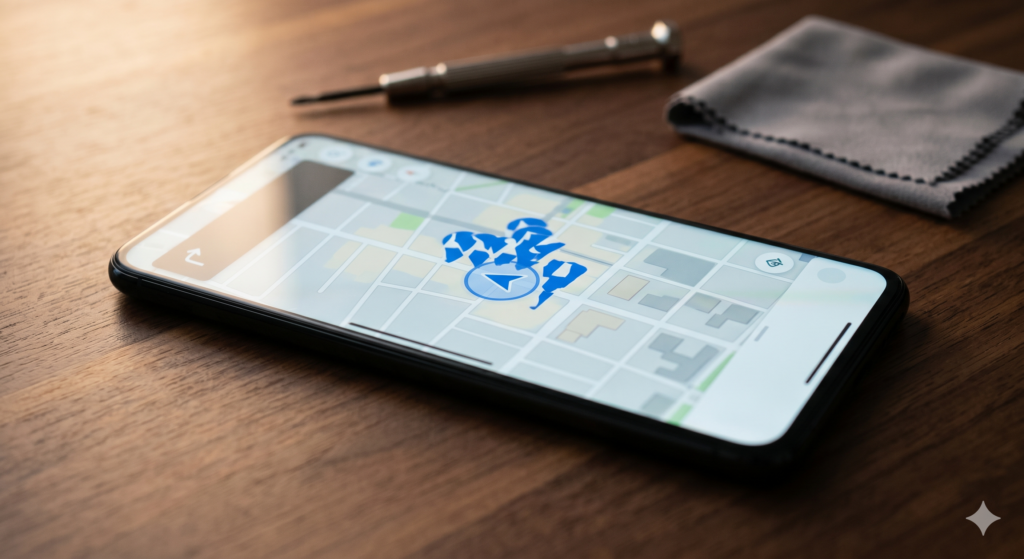
Is your phone GPS keeps losing location in the middle of a drive, or does it place you on the wrong street entirely? You are not alone. We see this issue almost every week at our Sheridan Blvd shop in Denver. People walk in frustrated because their navigation app sent them the wrong way, their fitness tracker stopped recording, or rideshare drivers can’t find them at pickup.
This guide will show you how to find the real cause, try the easy fixes first, and know when the problem lives inside the phone itself. Everything here comes from real bench work, not theory. Let us start with what is actually happening when GPS fails.
Section 1: Why Phone GPS Loses Location or Shows the Wrong Position
Your phone does not rely on satellites alone to find your location. Modern GPS is a blend of three systems working together. Real GPS satellite signals from space, Wi-Fi network triangulation from nearby routers, and cellular tower positioning from your carrier. According to NOAA’s official explanation of how GPS works, your phone needs a clear line of sight to at least four satellites for a precise fix.
The most common cause of GPS failure is a software glitch with the location services stack. After a major iOS or Android update, the GPS settings can get confused, and the phone keeps falling back to less accurate Wi-Fi positioning instead of using the GPS chip directly.
The second cause is hardware. The GPS antenna sits at the top edge of most phones, very close to the Wi-Fi and Bluetooth antennas. A cracked back glass, a bent frame from a drop, or a poorly done screen replacement can all damage or pinch the GPS antenna cable.
The third cause is environmental. Tall buildings, parking garages, and even heavy cloud cover can weaken satellite signals. This is normal, but the phone should recover within seconds. If yours does not, there is a real problem.
The fourth cause is a failing GPS chip itself. We see this more often on phones older than three years, especially after thermal stress damages the surrounding solder joints. This is similar to the kind of board-level wear we documented in our piece on NPU thermal cycle failures from 2026 AI agents.
Section 2: How to Fix Phone GPS Issues at Home (Step by Step)
Run through these steps in order. Most people fix the problem before the last step.
Step 1: Toggle Location Services Off and On
Open Settings, find Location Services or Location, turn it off, wait 10 seconds, then turn it back on. This forces the GPS stack to reload from scratch. It sounds basic, but we fix at least two phones a week with just this step.
Step 2: Restart Your Phone
Hold the power button and restart. This clears any cached location data and forces the GPS module to do a fresh satellite acquisition.
Step 3: Check App-Level Permissions
Go into Settings, Privacy or Privacy & Security, then Location Services. Make sure the app you are using has “While Using” or “Always” permission. Sometimes a permission gets reset to “Never” after an update without warning.
Step 4: Step Outside and Test
Walk to an open area away from buildings, trees, and tall structures. Open a navigation app and wait 30 to 60 seconds. If the location locks accurately outside but not indoors, the issue is environmental, not your phone.
Step 5: Disable VPN Temporarily
Many users do not realize their VPN is actively interfering with location-based features. Turn off any active VPN and test again. If GPS works without the VPN, you have your answer.
Step 6: Reset Location and Privacy Settings
On iPhone go to Settings, General, Transfer or Reset, Reset, then Reset Location & Privacy. On Android the path is usually under Settings, System, Reset Options, then Reset Wi-Fi, Mobile & Bluetooth. This wipes corrupted GPS calibration data without affecting your photos, apps, or contacts.
Step 7: Update Your OS and Maps Apps
Open the App Store or Play Store and check for pending updates. GPS-related bugs are some of the most patched issues in modern phone updates.
Step 8: Recalibrate the Compass (Apple Maps and Google Maps)
Open Maps, tap the location dot, and you will see a calibration prompt. Hold the phone level and move it in a figure-eight motion several times. A miscalibrated compass is one of the top causes of phones showing the right location but wrong direction.
Section 3: How to Get GPS Hardware Repaired Safely
If the steps above did not help, the GPS antenna or chip is likely the issue. Here is how to handle it the right way.
Get a proper diagnostic first. A failing GPS can hide deeper hardware problems. The same antenna assembly often handles GPS, Wi-Fi, and Bluetooth, so a single damaged cable can affect all three. A good shop tests each system separately before quoting any repair.
Check for prior drops or back glass damage. If your phone has been dropped recently, especially on its top edge, the GPS antenna cable is the first thing we check. A small dent or bent corner can pinch the cable enough to kill the signal without anything looking obviously wrong from outside.
Watch out for screen replacement issues. A poorly done screen replacement can pinch the GPS antenna cable that runs along the top of the phone. We see this often when customers come in after getting work done elsewhere. This relates closely to the kinds of post-repair issues we covered in our piece on the data deadlock and U4 IC failures.
Avoid DIY antenna kits. GPS antenna replacement requires removing the screen, the battery, and reaching into the top of the device where flex cables are densely packed. We see at least one botched DIY job a month. Bent connectors, torn coaxial cables, and severed antenna pads are all common.
Consider a full diagnostic at our shop. For most people, a professional GPS diagnostic takes under 20 minutes. Our iPhone repair team and Samsung repair specialists handle GPS and antenna repairs regularly. You can get an instant quote before deciding, and we will always tell you straight whether a fix is worth the cost.
Section 4: Conclusion and Final Thoughts
If your phone GPS keeps losing location or showing the wrong position, the cause is almost always a software glitch, a permissions issue, an interfering VPN, or a damaged antenna. The good news is that the first three causes have clear DIY fixes. Toggle location services, check app permissions, recalibrate the compass, and step outside to test in clear sky.
The most important thing is to test in multiple locations before assuming the phone is broken. We see customers come in convinced they need a chip-level repair, only to find out the issue was a stuck VPN setting or a misconfigured permission. Always rule out the easy stuff first.
If you are in the Denver area and the GPS problem follows your phone everywhere, even outdoors with a clear sky, bring it in. We will run a proper diagnostic, show you what is actually happening, and give you honest options. Same-day repairs are possible for most antenna issues, and we offer a 30-day warranty on every repair.
FAQs
Q: Why does my GPS work in some apps but not others?
That is almost always a permission issue. Each app needs its own location permission, and one app having it does not mean the others do. Check each app’s permission individually under Settings.
Q: Can a screen protector affect GPS accuracy?
No. The GPS antenna is internal and not blocked by glass or plastic on the front of the phone. If a new screen protector seems to have caused GPS issues, the real cause is usually a misaligned screen replacement underneath.
Q: How much does a phone GPS antenna repair cost in 2026?
For most models, a GPS antenna or cable replacement is one of the more affordable repairs, often under $100. A full GPS chip replacement at the board level costs significantly more because it requires micro-soldering. We always quote upfront after a diagnostic.
Q: Will airplane mode fix a stuck GPS?
Sometimes. Toggling airplane mode on for 30 seconds and then off forces the phone to re-register with cellular and re-acquire GPS from scratch. It is worth trying before more drastic steps.
Q: My GPS works fine outdoors but never indoors. Is that normal?
Yes, mostly. GPS satellite signals do not penetrate concrete or metal well. Modern phones supplement GPS indoors with Wi-Fi and cellular triangulation, but accuracy drops to 30 to 100 meters indoors versus 3 to 5 meters outdoors with a clear sky.
Disclaimer
This article is for informational purposes only and reflects observations from our Denver repair shop. GPS behavior varies by device, environment, and software version. For specific issues, consult the original manufacturer or a trusted local repair professional.
Nobody thinks twice about a phone case. You pick one that looks good, feels right in the hand, and protects against drops. Maybe you splurge on a rugged option. Maybe you go ultra-thin because you hate bulk. Either way, the case goes on and stays on — usually for the life of the device.
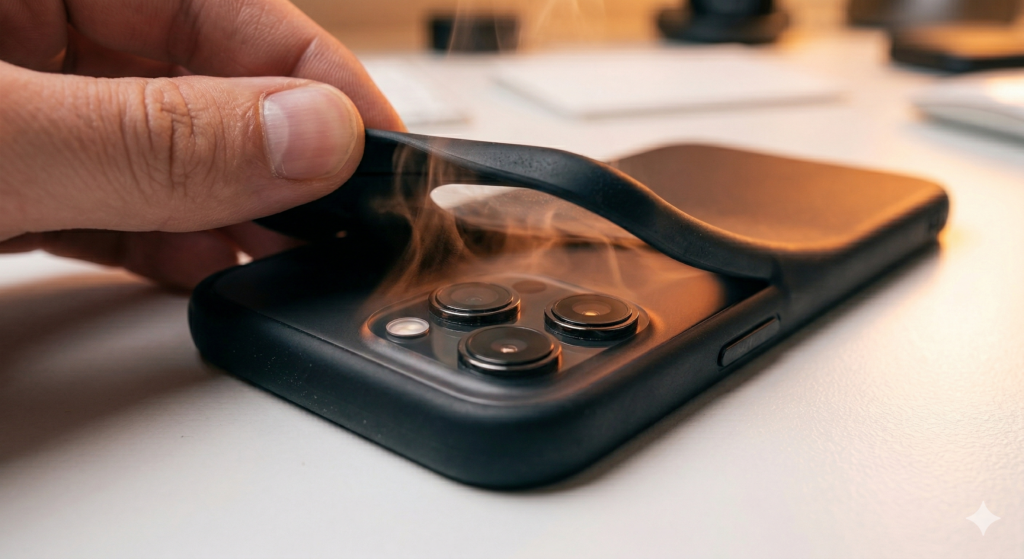
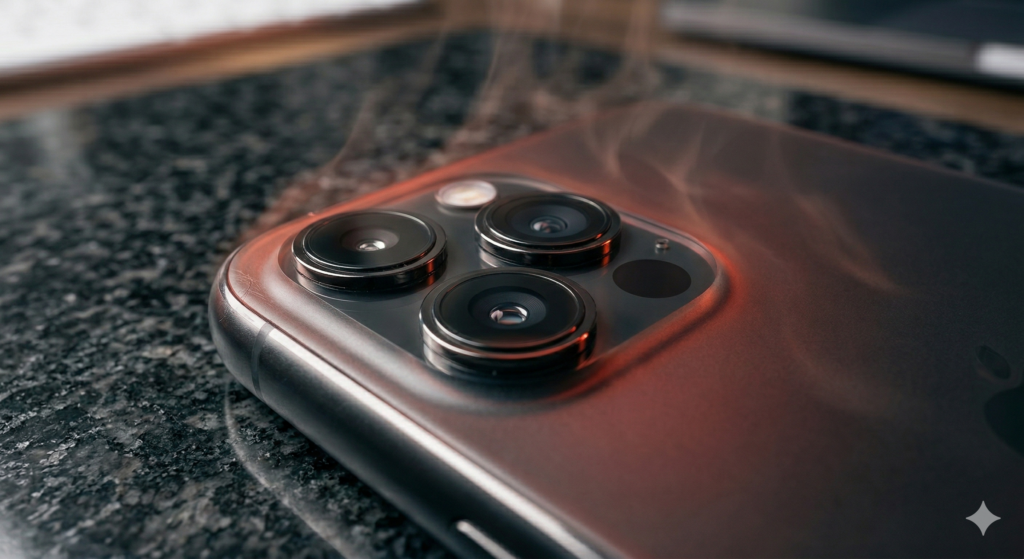
But here’s something most people never consider: your phone case directly affects how well your device manages heat. And in 2026, with processors running hotter than ever and phone bodies getting thinner by the generation, the wrong case doesn’t just trap warmth. It actively contributes to phone case heat dissipation failure that can warp internal components, degrade solder joints, and slowly strangle the logic board.
At iMobile Denver, we started noticing this pattern in late 2025. Customers brought in phones with warped frames, intermittent shutdowns, and failing components. No water damage. No major drops. The common denominator? Ultra-tight, poorly ventilated cases that turned their phones into pocket-sized ovens. This guide explains exactly how case design affects thermal management, what kind of internal damage results, and how to protect your device without giving up protection.
Section 1: Why Phone Heat Management Matters More in 2026 Than Ever Before
The Thermal Design Reality of Modern Flagships
Every flagship phone generates significant heat during normal use. The processor, modem, display driver, and battery all produce thermal energy. Manufacturers design the phone body itself — typically aluminum and glass — to act as a passive heat sink. Heat travels from the logic board through thermal paste and graphite sheets to the metal frame, then radiates outward through the exterior surfaces.
This system works when those exterior surfaces can actually radiate heat into the surrounding air. The moment you wrap the phone in an insulating layer, you reduce that radiation. A thin case slows heat escape. A thick, tightly sealed case blocks it almost entirely.
Why 2026 Phones Run Hotter Than Previous Generations
Three converging trends make thermal management harder this year.
On-device AI never stops. As we covered in our post on NPU thermal cycle failures, persistent AI workloads keep processors engaged at moderate heat levels for hours. The phone never fully cools between tasks.
5G modems generate constant background heat. Maintaining a 5G connection — especially switching between mmWave and sub-6 bands — requires continuous radio power. Our guide on 5G signal hardware problems explains how modem heat contributes to overall thermal load.
Thinner phone bodies reduce thermal mass. Less metal and glass means less material to absorb and distribute heat. The phone reaches peak temperature faster and stays there longer.
Add an insulating case to that equation and temperatures climb even higher. The phone throttles. Performance drops. And inside, the heat starts doing real damage.
Section 2: How the Wrong Case Creates a Heat Trap That Damages Your Phone
The Insulation Effect of Ultra-Thin and Sealed Cases
Not all cases cause problems equally. The worst offenders share specific design traits:
Silicone or rubber cases with full back coverage. These materials insulate rather than conduct. They trap the heat the phone body tries to radiate. The back panel — your phone’s primary cooling surface — can’t breathe.
MagSafe cases with thick magnetic rings. The metal ring improves accessory alignment but adds a localized heat source when used with wireless chargers. Combined with case insulation, the area around the charging coil gets dangerously warm.
Wallet cases and folio designs. These cover both the front and back of the phone. Heat has nowhere to escape. We’ve measured surface temperature differences of 8 to 12°C between a cased and uncased phone running the same workload.
Tightly molded cases with zero air gap. Cases that press firmly against every surface eliminate the thin air buffer that helps convection cooling. Even a fraction of a millimeter of air gap makes a measurable difference in heat dissipation.
What Happens Inside When Heat Can’t Escape
When a phone runs consistently 5 to 10 degrees hotter than its design intended, the damage accumulates across multiple components:
Logic board warping. The printed circuit board (PCB) that holds every chip in your phone consists of layers of fiberglass and copper traces. Sustained heat causes these layers to expand unevenly. Over months, the board develops a subtle bow. That warp stresses solder joints. Chips lose reliable contact with their connection points. The result? Intermittent failures that come and go unpredictably.
Accelerated solder joint fatigue. Higher operating temperatures mean larger thermal expansion cycles. Solder joints that would survive five years under normal conditions fail in two. We see this frequently when customers bring in phones with random restarts or display flickering — symptoms that trace back to weakened connections on a heat-stressed board.
Battery degradation. Lithium-ion batteries lose capacity faster at higher temperatures. A phone that consistently runs 8°C hotter than designed ages its battery roughly 30% faster. Customers notice battery drain accelerating — then bring the phone in thinking the battery failed on its own. In reality, the case contributed significantly.
Adhesive breakdown. Internal adhesives hold components like the display, back glass, and battery in place. Heat softens these adhesives over time. Screens lift slightly at the edges. Back panels loosen. In extreme cases, a softened battery adhesive allows the cell to shift position and press against other components.
Section 3: How to Choose a Case That Protects Without Strangling Your Phone
What to Look For in a Thermally Safe Case
Drop protection and thermal management aren’t mutually exclusive. Good case design accounts for both.
Raised edges with open ventilation. Cases that lift slightly away from the phone body at the back create an air gap. This allows passive convection — warm air rises away from the surface and cooler air replaces it. Even a 0.5mm gap makes a difference.
Hard-shell materials over soft silicone. Polycarbonate and hard TPU conduct heat better than soft silicone or rubber. They still absorb impact but don’t insulate the phone as aggressively.
Open bottom and top cutouts. Cases that leave the speaker grilles, charging port, and top edge exposed allow heat to escape from multiple points. Fully enclosed designs trap heat from every direction.
Avoid stacking magnetic accessories. MagSafe wallet plus battery pack plus case creates three insulating layers behind the phone. Each one compounds the heat retention. If you must use magnetic accessories, remove them during heavy use or charging.
When to Take the Case Off Entirely
During any extended high-performance task — gaming, video editing, GPS navigation, or video calls longer than 20 minutes — remove the case. Let the phone’s metal and glass body do what it was designed to do. You can put the case back on when the task ends.
If you charge wirelessly, remove the case during charging. Wireless charging generates more heat than wired charging. Adding case insulation on top of that pushes temperatures into the danger zone.
Signs Your Case Already Caused Damage
Watch for these symptoms. Any combination suggests heat-related internal stress:
Battery health dropping faster than expected for the phone’s age
Random restarts that increase in frequency over weeks
The phone feeling unusually warm even during light tasks — with the case on
If any of these match, bring the phone in for a diagnostic. Our iPhone repair and Samsung repair teams check for board warping, solder fatigue, and thermal damage as part of every assessment.
Section 4: Conclusion and Final Thoughts
A phone case should protect your device. It shouldn’t slowly cook it from the inside. But in 2026 — with hotter processors, persistent AI workloads, 5G modems, and increasingly thin phone bodies — the wrong case turns a manageable thermal load into a destructive one.
Logic board warping doesn’t happen overnight. Solder fatigue builds gradually. Battery degradation accelerates quietly. By the time symptoms appear — random restarts, failing sensors, rapid battery drain — months of cumulative heat damage already occurred inside the case.
The fix isn’t complicated. Choose cases with air gaps and hard-shell materials. Avoid stacking insulating accessories. Remove the case during heavy tasks and wireless charging. Monitor battery health as an early warning indicator.
And if your phone already shows symptoms, don’t dismiss them as “just getting old.” A professional diagnostic at iMobile Denver can distinguish between normal wear and heat-related component failure. Catching thermal damage early often means a targeted repair rather than a full replacement.
Not through impact — that’s what cases prevent. But a poorly ventilated case traps heat the phone generates during normal use. Over months, sustained elevated temperatures weaken solder joints, degrade batteries, and warp the logic board. The case doesn’t cause a single catastrophic failure. It creates a slow accumulation of thermal stress that eventually produces symptoms.
Which case materials trap the most heat?
Soft silicone and rubber rank worst for heat retention. Leather folio cases come second because they cover both sides. Hard polycarbonate and rigid TPU cases perform better because they conduct rather than insulate. Metal cases can actually help dissipation — but watch for interference with wireless signals.
Does wireless charging make the case heat problem worse?
Yes. Wireless charging generates more heat than wired charging. A case trapping that heat against the back panel pushes internal temperatures higher. Always remove the case during wireless charging, or at minimum use a case specifically designed with wireless charging ventilation in mind.
Repair and Damage Questions
How do I know if my logic board warped from heat?
Warped boards produce intermittent, inconsistent symptoms. Random restarts, sensors that fail then work again, or connections that cut in and out all suggest stressed solder joints from board deformation. A technician uses magnification and thermal imaging to identify warping and micro-fractures. Bring it to our Denver shop for inspection.
Can heat damage from a case void my warranty?
Manufacturer warranties typically don’t cover damage from third-party accessories. If Apple or Samsung determines that a case contributed to thermal damage, they may classify it as accidental damage. Independent repair shops like iMobile Denver repair heat-related failures regardless of cause — and at a fraction of manufacturer pricing.
Should I stop using a case entirely?
Not necessarily. Cases still protect against drops, scratches, and daily wear. The goal is choosing a case that protects without insulating. Look for hard-shell designs with raised backs, ventilation channels, and open cutouts. Remove it during heavy use and wireless charging. That balance gives you drop protection without the thermal penalty.
You dropped your phone. Nothing dramatic — it slipped off the couch, bounced off a car seat, or tumbled out of your pocket onto a sidewalk. The screen looks fine. No cracks. No visible damage. But now Night Mode photos come out blurry and flat. Augmented reality apps can’t map your room. Portrait mode produces muddy depth separation that used to look razor sharp.
When your phone’s LiDAR is not working after a drop, the connection between cause and effect isn’t obvious. Most people blame a software glitch or a camera update. They restart the phone, clear the camera cache, or factory reset — none of which helps. Because the LiDAR scanner sits behind a tiny window on the back of your phone, and even a minor impact can knock it out of alignment without leaving a single visible mark.
At iMobile Denver, we’ve diagnosed this exact failure pattern across dozens of flagship devices since LiDAR became standard on pro models. The sensor looks untouched from the outside. But inside, the precision alignment that makes depth sensing work shifted by fractions of a millimeter — enough to break Night Mode, AR, and portrait photography all at once. This guide explains what LiDAR does, why drops damage it so easily, and what repair actually involves.
Section 1: What LiDAR Does in Your Phone and Why It Matters More Than You Think
The Technology Behind the Tiny Sensor
LiDAR stands for Light Detection and Ranging. Your phone’s LiDAR scanner fires thousands of invisible infrared laser pulses per second. These pulses bounce off objects in front of the camera and return to a sensor that measures how long each pulse took to travel back. From those timing measurements, the phone builds a precise 3D depth map of the scene.
This depth map powers several features you probably use without realizing LiDAR is involved.
Features That Depend on LiDAR Working Correctly
Night Mode and low-light photography. The depth map helps the camera system focus faster and more accurately in darkness. Without it, the autofocus hunts and guesses. Photos come out softer. Focus locks on the wrong plane. The dramatic improvement Night Mode delivers on pro models comes partly from LiDAR data — not just computational photography.
Portrait Mode depth separation. LiDAR provides the accurate edge detection that separates your subject from the background. When the scanner misaligns, Portrait Mode loses precision. Hair blends into the blur. Edges look artificial and jagged. The “professional camera” effect falls apart.
Augmented reality applications. AR apps like measuring tools, furniture placement viewers, and gaming overlays rely entirely on the depth map. A misaligned LiDAR scanner delivers inaccurate spatial data. Objects float above surfaces. Measurements read wrong. AR games glitch and lose tracking.
Face ID accuracy (on some models). Certain flagship phones share components between the rear LiDAR scanner and the front-facing depth sensor array. Damage to one system can affect calibration data that the other references. We’ve seen cases where a rear LiDAR failure coincided with intermittent Face ID problems — a connection most users never suspect. Our post on proximity sensor troubleshooting covers similar front-facing sensor calibration issues.
Section 2: Why Minor Drops Damage LiDAR When Nothing Else Breaks
The Precision Problem
A phone screen can absorb significant impact. Modern glass is designed to flex and distribute force. The frame bends slightly and springs back. Internal components mount on shock-absorbing gaskets and flex cables with slack.
LiDAR doesn’t get those luxuries. The scanner requires near-perfect optical alignment between the laser emitter and the infrared receiver. These components mount rigidly — any flex would distort the depth measurements. That rigidity makes LiDAR accurate. It also makes it fragile.
A drop that barely scuffs the phone case can transmit enough shock through the chassis to shift the LiDAR module by a fraction of a millimeter. The emitter and receiver fall out of sync. Laser pulses leave at one angle and return to a sensor that no longer expects them at that position. The depth map degrades or fails entirely.
What We See During Diagnostics
At our Sheridan Blvd. location, LiDAR-related diagnostics follow a consistent pattern. The customer says Night Mode “got worse” or AR “stopped working.” They don’t connect it to a drop that happened days or weeks earlier because nothing looked broken.
We open the device and find one of three things:
The LiDAR module shifted on its mounting bracket. The adhesive or screws holding the module loosened from impact shock. The module physically moved. Repositioning and resecuring it restores function.
The infrared window cracked internally. The tiny glass or sapphire window covering the LiDAR sits flush with the camera housing. It can fracture behind the surface without any visible damage outside. A cracked window scatters the infrared pulses and corrupts the return signal.
The flex cable connecting the LiDAR module to the logic board partially unseated. Just like the display flex cable, the LiDAR connector uses a small pressure-fit plug. Impact can pop it partially loose. Data transmission becomes intermittent — the scanner works sometimes and fails randomly other times.
These failures don’t produce error messages. The camera app simply delivers worse results. Most users assume the software degraded, not the hardware.
Section 3: How to Diagnose and Fix LiDAR Problems After a Drop
Quick Tests You Can Run at Home
Before bringing your phone in, try these checks to confirm the LiDAR scanner is the issue:
Test AR functionality. Open the Measure app (iPhone) or any AR app (Android). Point the camera at a flat surface. If the app can’t detect the surface, takes much longer than usual, or produces wildly inaccurate measurements, the depth sensor isn’t feeding reliable data.
Compare Night Mode to a known-good device. Take the same low-light photo with your phone and a friend’s identical model. If yours consistently produces softer focus or slower autofocus lock, the LiDAR-assisted focusing system is underperforming.
Check Portrait Mode edges. Take a portrait photo of someone with detailed hair. Zoom in on the edge between the subject and the blurred background. If the separation looks rough, jagged, or cuts into the subject’s outline, the depth map lost accuracy.
Look for the infrared emitter. Open the camera in a dark room and look at the LiDAR window through another phone’s front camera. You should see a faint grid of infrared dots. If the dots appear scattered, dim, or absent on one side, the emitter or window is damaged.
When Professional Repair Makes Sense
If those tests confirm a problem, software fixes won’t help. The damage is physical. Restarting the phone, updating iOS or Android, or resetting camera settings addresses nothing when the sensor shifted or cracked.
At iMobile Denver, LiDAR repair involves opening the device, inspecting the module alignment, checking the infrared window, and testing the flex cable connection. If the module simply shifted, repositioning it and reinforcing the mount takes under an hour. A cracked infrared window requires a replacement part. A damaged flex cable gets swapped.
For Samsung flagship devices with depth-sensing cameras (like the Galaxy S and Note Ultra series), the process is similar but uses different sensor architectures. Our smartphone repair team handles both ecosystems.
The key is catching the problem early. A shifted LiDAR module that sits misaligned for months can eventually damage the flex cable from sustained uneven pressure. What starts as a $50 to $80 realignment becomes a more involved repair if neglected.
LiDAR transformed what smartphone cameras can do. Night Mode on pro-model phones produces photos that rival dedicated cameras in low light. AR applications map physical spaces with centimeter-level accuracy. Portrait Mode creates depth separation that looks genuinely professional. All of that depends on a tiny sensor maintaining precise optical alignment — alignment that a minor drop can silently destroy.
The frustrating part is how invisible the damage looks. No cracked screen. The lens looks fine. Not a single error message tells you what happened. Just gradually worse photos, broken AR tracking, and a vague feeling that your camera “isn’t as good as it used to be.”
If your flagship phone’s Night Mode, Portrait Mode, or AR features degraded — especially after any kind of drop, bump, or impact — don’t waste time reinstalling apps or resetting settings. The LiDAR scanner almost certainly needs physical inspection.
Stop by our Denver location or contact us for a diagnostic. We’ll tell you exactly what shifted, what broke, and what it takes to restore your camera system to full capability. Most LiDAR repairs finish same-day, and every repair comes with our standard warranty.
iPhones starting with the iPhone 12 Pro and all subsequent Pro/Pro Max models include LiDAR. On Android, Samsung Galaxy Ultra models and certain Google Pixel Pro models use depth-sensing cameras with similar functionality. Check your phone’s spec sheet or look for a small dark circle near the rear camera lenses — that’s the infrared window.
Can a phone case prevent LiDAR damage from drops?
A case absorbs some impact force, which helps. But LiDAR damage comes from internal shock transmission through the chassis, not from direct contact with the sensor window. A case reduces the severity of the shock but can’t eliminate it entirely. It’s still good protection — just not a guarantee.
Why didn’t my phone show any error after the drop?
Phones don’t monitor LiDAR alignment in real time. The sensor either sends data or it doesn’t. A partially misaligned scanner still sends data — just inaccurate data. The camera app doesn’t know the depth map is wrong. It processes whatever the scanner provides and delivers degraded results without any warning.
Repair Questions
How much does LiDAR repair cost?
It depends on the phone model and the specific damage. A simple module realignment costs less than a window or flex cable replacement. Get an instant quote for your exact device and situation.
Will a camera replacement fix LiDAR problems?
Not necessarily. The LiDAR scanner and the main camera are separate modules. Replacing the camera lens won’t fix a shifted or cracked LiDAR sensor. A proper diagnostic identifies which component failed so you don’t pay for parts you don’t need.
Does LiDAR damage get worse over time?
It can. A shifted module puts uneven stress on its flex cable and mounting points. Vibrations from daily use, temperature changes, and subsequent minor impacts can worsen the misalignment. What starts as slightly soft Night Mode photos can progress to complete AR failure if left unaddressed for months.
Few things are more maddening than watching your laptop, tablet, and smart TV all hum along on Wi-Fi — while your phone sits there stubbornly refusing to connect. You’ve restarted it a dozen times. Airplane mode has been toggled on and off more than you’d care to admit. Maybe you’ve even yelled at the thing a little. And still, nothing. If your phone won’t connect to Wi-Fi even though every other device in your house is online, you’re not dealing with a router problem. The issue lives inside the phone itself. And the good news? Most of the time it’s fixable.
At iMobile Denver, we see this issue walk through our doors multiple times a week. After years of hands-on diagnostics, we’ve learned that the cause usually falls into a handful of categories — some software, some hardware, and a few that surprise people. This guide breaks down the real reasons your phone might be refusing Wi-Fi and exactly what to do about each one.
Section 1: Why Your Phone Specifically Loses Wi-Fi While Other Devices Stay Connected
Before you start factory resetting anything, it helps to understand why this happens to one device and not the rest.
How Your Phone’s Wi-Fi Connection Actually Works
Every device on your network negotiates its own individual connection with your router. Your phone has its own Wi-Fi antenna, its own network chipset, and its own software stack handling that handshake. So when something goes wrong on your phone’s end — whether it’s a corrupted network profile, a software glitch, or a damaged antenna — it has zero effect on your other devices.
The Most Common Root Causes
Here are the most common root causes we identify during smartphone repair appointments:
Corrupted saved network data. Your phone stores Wi-Fi credentials and connection parameters. Sometimes that saved profile gets corrupted after an update or unexpected restart, and the phone just silently fails to connect.
IP address conflict. If another device grabbed the same local IP your phone was using, the router may reject your phone’s connection attempt. This happens more often than people think, especially on crowded home networks.
Outdated or buggy firmware. A bad OS update can break Wi-Fi drivers. We’ve seen this repeatedly with both iPhones and Samsung Galaxy devices after major version releases.
Physical antenna damage. Drops, water exposure, or even a previous screen repair done incorrectly can disturb the internal Wi-Fi antenna. This is the scenario most people don’t consider, but it’s surprisingly common. If your phone recently had any kind of physical damage, our iPhone repair and Samsung repair teams can inspect the antenna connections during a diagnostic.
Understanding which of these applies to your situation makes the difference between wasting an hour on Google and actually solving the problem.
Section 2: Step-by-Step Troubleshooting When Your Phone Won’t Connect to Wi-Fi
Let’s walk through fixes in order, from quickest to most involved. Try each one before moving to the next.
Step 1: Forget the Network and Reconnect
Go to your Wi-Fi settings, tap on your home network, and select “Forget.” Then reconnect by entering the password fresh. This clears the saved profile and forces your phone to negotiate a completely new connection. It solves the issue roughly 30–40% of the time in our experience.
Step 2: Reset Your Network Settings
On iPhone, go to Settings > General > Transfer or Reset iPhone > Reset > Reset Network Settings. On Android, it’s typically under Settings > System > Reset Options > Reset Wi-Fi, Mobile & Bluetooth. This wipes all saved networks, Bluetooth pairings, and VPN configs. It’s more aggressive than Step 1 but catches deeper software corruption.
A heads up — you’ll need to re-enter passwords for every Wi-Fi network after doing this.
Step 3: Check for Software Updates
Manufacturers regularly patch Wi-Fi connectivity bugs. If you’ve been postponing that system update notification, now is the time. Apple and Google both document known Wi-Fi bugs in their release notes, and sometimes a simple update is the entire fix.
Step 4: Toggle MAC Randomization Off
Modern phones randomize their MAC address for privacy. Occasionally, this confuses certain routers — particularly older ones or those provided by ISPs. Go to your Wi-Fi network’s advanced settings and switch to “Use Device MAC” instead of a randomized one. We’ve seen this fix connectivity on dozens of devices where nothing else worked.
Step 5: Boot Into Safe Mode
Android users can restart in Safe Mode (hold the power button, then long-press “Power Off” until Safe Mode appears). If Wi-Fi works perfectly in Safe Mode, a third-party app is interfering — typically a VPN, ad blocker, or battery optimization tool. Remove recently installed apps one by one until you find the culprit.
iPhone users don’t have a traditional Safe Mode, but you can test by going to Settings > VPN and disabling any active VPN profiles.
Step 6: Try a Different Wi-Fi Band
If your router broadcasts both 2.4GHz and 5GHz networks with different names, try connecting to the one you aren’t currently using. Some phones have intermittent issues with one band but work fine on the other. This can at least get you connected while you work on a permanent fix.
For a deeper dive into connectivity-related hardware failures, our post on why 5G phones keep dropping to “No Service” covers the antenna and modem-level issues that affect wireless connections broadly.
Section 3: When Software Fixes Don’t Work — Recognizing a Hardware Problem
Here’s the honest part that most online guides skip: sometimes the problem isn’t software at all.
If you’ve gone through every step above and your phone still won’t connect to Wi-Fi — or it connects but drops constantly, or shows an absurdly weak signal while standing next to the router — there’s a good chance you’re looking at a hardware fault.
Common Hardware Culprits
Damaged or disconnected Wi-Fi antenna flex cable. Inside your phone, the Wi-Fi antenna connects to the logic board through a tiny flex cable and connector. A drop can pop it loose, and even a poor-quality screen replacement can pinch or tear it. We regularly find this during diagnostics at our Denver repair shop, and reconnecting or replacing the flex cable usually resolves the issue within minutes.
Corroded or water-damaged Wi-Fi chip. Water exposure doesn’t always kill a phone outright. Sometimes it corrodes individual components over weeks. The Wi-Fi and Bluetooth chip is particularly vulnerable because of its position on the logic board in many phone models. If your phone was exposed to moisture even months ago, this could be the culprit.
Faulty logic board solder joints. On older devices or phones that have been through extreme temperature changes, micro-fractures in solder joints can cause intermittent connectivity loss. This is a board-level repair and requires professional micro-soldering.
When to Seek Professional Help
If none of the software troubleshooting above made a difference, it’s time to bring the phone in for a physical inspection. Continuing to mess with settings at that point is just spinning your wheels. A professional diagnostic can identify the exact failed component — and in many cases, the repair is quicker and cheaper than people expect.
According to the FCC’s guide on wireless device interference, physical obstructions and hardware faults remain leading causes of device-specific connectivity failure — so you’re not imagining things if your phone is the only one struggling.
Section 4: Conclusion and Final Thoughts
A phone that won’t connect to Wi-Fi when everything else is working fine is almost always a phone-level issue — not a network one. That’s actually the reassuring part. It means the problem has a specific cause and, in most cases, a straightforward solution.
Start with the software basics: forget the network, reset your network settings, check for updates, and rule out app interference. These steps resolve the majority of cases we see. But if the problem persists — especially after a drop, water incident, or screen repair — the answer is almost certainly hardware-related. A loose antenna cable, corroded chip, or damaged connector won’t fix itself with a reboot.
The worst thing you can do is ignore it and assume it’ll go away. Wi-Fi issues caused by hardware tend to get worse over time, not better. Getting a professional repair evaluation sooner rather than later can save you money and prevent data loss from more aggressive DIY attempts like factory resets.
If you’re in the Denver area, reach out to our team — we’ll tell you straight whether it’s something you can fix at home or something we need to open up and look at.
FAQs
Why does my phone say “connected” to Wi-Fi but have no internet?
This typically means your phone successfully authenticated with the router, but the router isn’t passing internet traffic to your device. It’s often an IP conflict or a DNS issue. Try forgetting the network and reconnecting, or manually set your DNS to 8.8.8.8 (Google’s public DNS) in your Wi-Fi settings.
Can a cracked screen cause Wi-Fi problems?
Not the crack itself — but the repair can. If a screen replacement was done improperly, the technician may have disconnected or damaged the Wi-Fi antenna cable that runs near the display assembly. We see this more often than you’d think, which is one reason quality repairs from experienced technicians matter.
Does a phone case block Wi-Fi signal?
Most standard cases don’t cause issues. But heavy-duty metal cases or cases with magnetic mounts can interfere with wireless signals. If you’re troubleshooting, try removing your case entirely and testing the connection bare.
Should I factory reset my phone to fix Wi-Fi?
A factory reset should be a last resort, not a first step. It wipes all your data and apps and doesn’t fix hardware problems. Try the less destructive steps in this guide first — resetting network settings alone solves the problem for most people without touching your photos, apps, or messages.
How do I know if my phone’s Wi-Fi antenna is broken?
The biggest clue is weak signal strength even when you’re standing right next to the router, or Bluetooth also acting unreliable (since Wi-Fi and Bluetooth often share the same chip). If both wireless functions are struggling, there’s very likely a hardware fault. A quick diagnostic at a repair shop like ours can confirm it in minutes.
This guide is based on real-world repair experience at iMobile Denver. While these troubleshooting steps resolve the majority of Wi-Fi connectivity issues, every device is different. If you’re unsure about opening your phone or performing any hardware-level fix, we always recommend consulting with a qualified repair professional to avoid further damage.